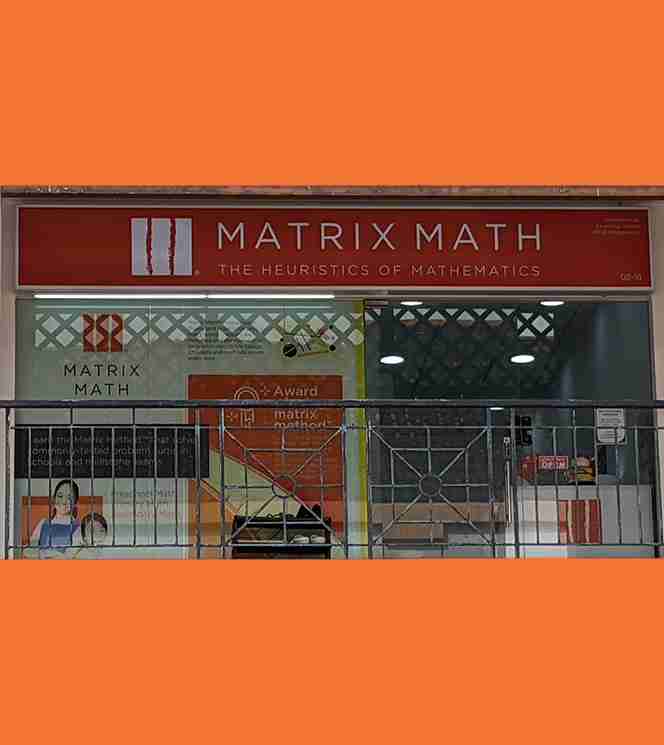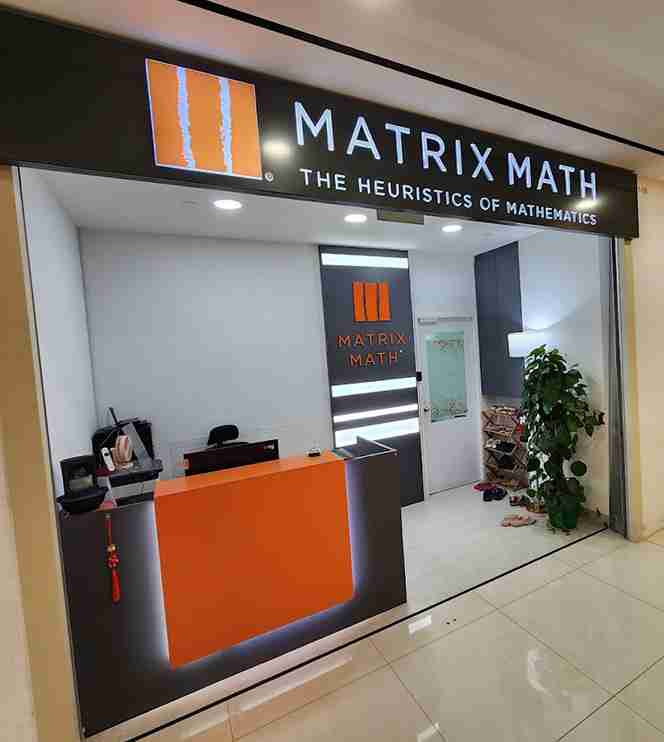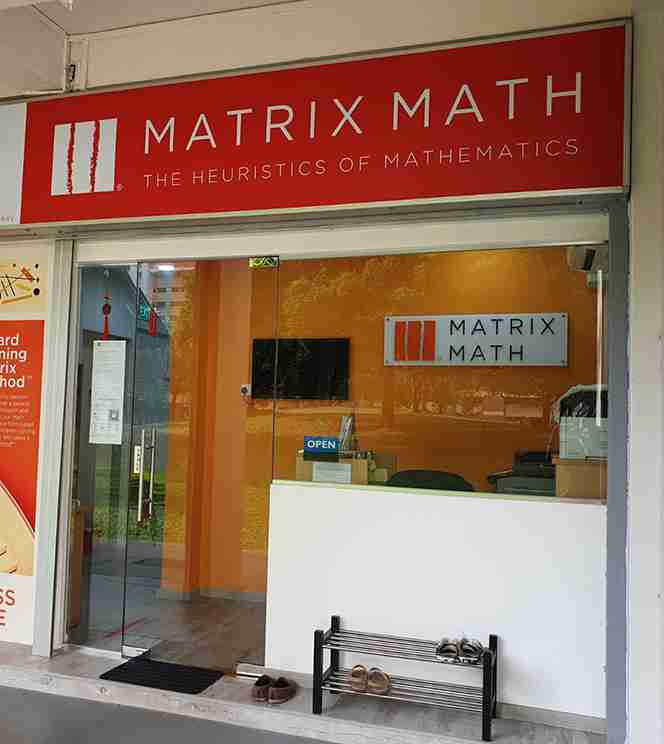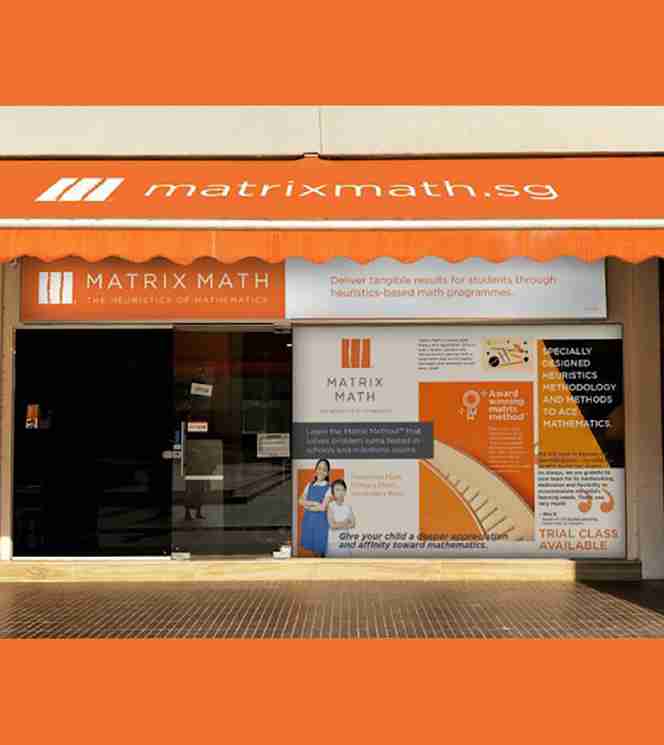














main banner img

Are you in need of a top-notch maths tuition centre in Singapore? We provide comprehensive class-based and online tuition for PSLE and O-Level maths. Your children will have their reasoning and problem-solving skills trained as we help them excel in mathematics.

main banner students
about left 1
about right 1
about left mobile 1
about right mobile 1

WELCOME TO

MATRIX MATH

BEST MATH TUITION SINGAPORE

At Matrix Math, we take pride in our innovative approach to math education for primary math tuition, secondary math tuition, PSLE revision and O level. The Matrix Method, which was originally developed in 2008, has undergone continuous refinement and improvement over the years. Our dedicated team of math specialists conducts extensive research to ensure that our programme remains in line with the MOE syllabus and addresses the most commonly tested concepts in schools.

Join us on this exciting journey of continuous improvement and witness the transformative power of the Matrix Method in empowering young minds to excel in math.

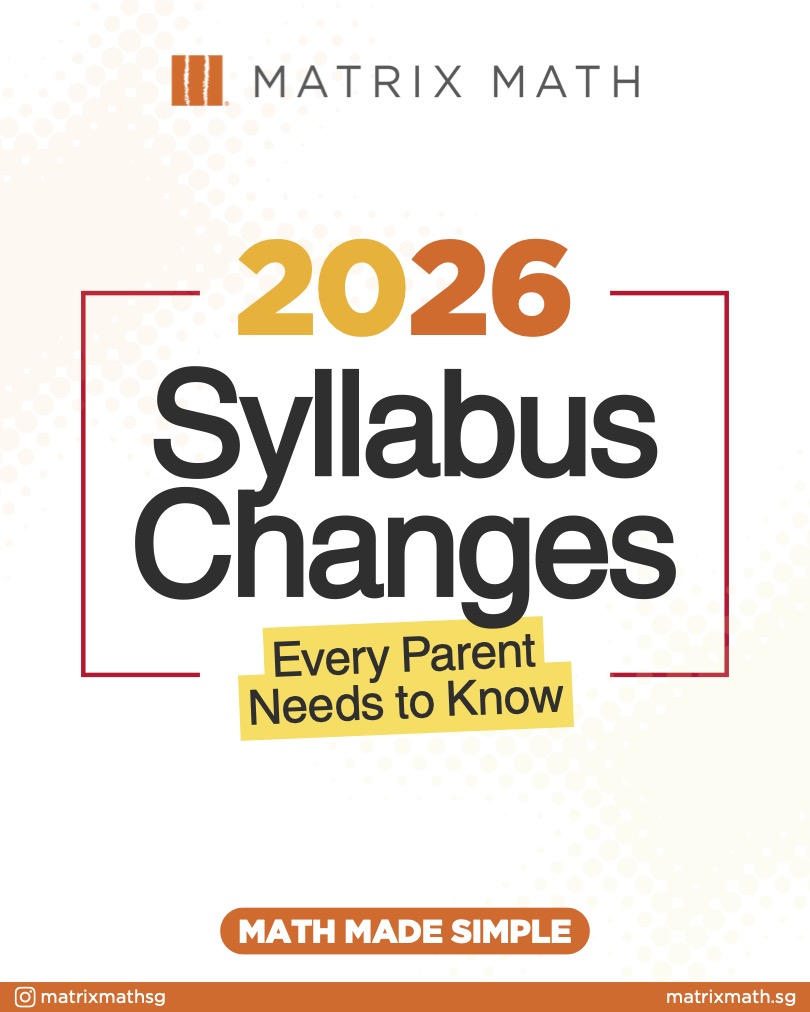
2026 MATH SYLLABUS CHANGES

WHAT EVERY PARENT NEEDS TO KNOW

2026 Syllabus changes

The Ministry of Education has announced several important updates to the 2026 Primary Math syllabus, including shifts in topic placement, assessment format, and mark allocation. These changes will significantly affect how students prepare for upper primary Math, especially in topics like Ratio, Averages, and visualization skills such as Nets — as outlined in our guide .

At Matrix Math, we stay ahead of syllabus updates to ensure our students receive the best math tuition support aligned with the latest MOE requirements. To help parents understand these changes clearly, we’ve prepared a concise, easy-to-read 2026 Math Syllabus Changes Guide.

This guide explains:

  • Topics moved across levels (e.g., Ratio & Average shifting to P6, Nets introduced in P4)

  • Format changes such as increased MCQ weighting and reduced long-answer questions

  • Paper duration and mark distribution adjustments in P5 & P6

  • What these changes mean for your child’s preparation


Click below to download your free guide and learn how to keep your child ahead of the new math syllabus.


WHAT MAKES US

DIFFERENT?

In this video, former Matrix Math students reunite to share their gratitude and fond memories of their journey with us. Many have been part of Matrix Math from primary school through Secondary 4. Their stories highlight the encouraging learning culture and supportive environment we provide, which sets us apart as a leading provider of math tuition in Singapore. At Matrix Math, we inspire a love for problem-solving and foster confidence, helping students excel in their learning journey.

math tuition center in singapore the matrix method
different 01 icon

GET REAL RESULTS WITH THE MATRIX METHOD

The Matrix Method, a thought process inspired by how successful students approach and process complex information. Through keen observation, we have cracked the code to understand how these students efficiently solve challenging word problems and translate them into systematic solutions. The result is a streamlined approach encompassing 5 simple and easy-to-follow steps.

However, our approach goes beyond just math problem-solving. At Matrix Math, we are committed to nurturing well-rounded learners by instilling good learning habits and cultivating essential thinking skills in our students. These skills are the building blocks of future success, extending far beyond the realm of mathematics.

matrix math tuition center study math smarter
different 02 icon

STUDY SMARTER

We prioritize academic excellence with a strategic approach, introducing "ROL" - Return on Learning.

To achieve the highest ROL, we structured our lesson plans to build upon previous knowledge and prepare students with essential skills for future concepts. We focus on laying strong foundations through a building-block method, gradually adding complexity to ensure students grasp each concept effectively.

As forgetting is a natural part of the learning process, our programme emphasises continual reinforcement, ensuring students can retain and apply their mathematical skills effectively.

With our math tuition center approach, students experience a comprehensive learning journey that not only enhances their math proficiency but also ensures lasting retention and application of knowledge.

matrix math tuition center foster independant learner
different 03 icon

INDEPENDENT LEARNER

We recognize that cultivating independence is a crucial aspect of a child's development. Independent learners are students who take ownership of their learning, thinking critically, and seeking answers on their own.

To foster independent learning, our teachers are specially trained to encourage students to think critically and question concepts instead of merely providing answers. We believe in nurturing their curiosity and problem-solving skills.

In addition, we have developed a range of self-learning online lessons and videos allowing students to explore essential topics and concepts at their own pace independently.

THE IMPORTANCE OF

HEURISTIC PROBLEM-SOLVING SKILLS

Importance of Learning Math

Mathematics plays a crucial role in shaping a student’s cognitive abilities, laying the groundwork for logical thinking, problem-solving, and decision-making. At Matrix Math, we believe that a strong foundation in math is essential not only for academic success but for navigating everyday life. From managing finances to interpreting data, math is everywhere, and mastering it equips students with essential life skills.

Challenges in learning math

However, the journey to math proficiency isn’t without challenges. Many students struggle with complex concepts, abstract reasoning, or problem-solving techniques that require deeper understanding and application. This is where we step in. At Matrix Math, we specialise in turning these challenges into learning opportunities through our structured, expert-guided approach. Our curriculum is meticulously designed to break down difficult topics and build strong problem-solving skills, focusing on areas like heuristic techniques to simplify even the toughest math problems.

BENEFITS OF MASTERING MATHS

The benefits of mastering math extend far beyond the classroom. Students who develop confidence in math often see improvements in critical thinking and analytical skills, which can lead to success in various fields. At Matrix Math, we are committed to guiding students through the challenges of math and helping them unlock their full potential with a tailored, effective programme.

image1
commitment popup
OUR COMMITMENT
We’re committed to empowering students to excel in math by overcoming common challenges and constantly exploring ways to simplify math.
Our unwavering commitment is reflected in our proprietary and award-winning Matrix Math method.

OUR PROGRAMMES

We have a wide range of programmes for children of all ages.

Features prerecorded video lessons by our skilled Math specialists, allowing students to explore math problem-solving concepts at their own pace.

A step-by-step learning journey focuses on closing knowledge gaps in maths through problem-solving skills rather than drilling exercises.

Designed to equip your child with the essential skills to excel in PSLE math.

Crafted based on in-depth research of top school examination papers, ensuring your child is well-prepared to tackle O-level Math Paper.

LEAD PROGRAMME MANAGER

Matrix Method Jason Hiak

JASON HIAK

An alumnus of Nanyang Technological University with a degree in Accountancy, Jason furthered his education with a Master’s from Manchester Business School.

As a Registered Chartered Accountant, Jason combines his deep analytical skills with over 20 years of teaching experience in Mathematics, specialising in primary school math.

His expertise and dedication have made him a key figure in shaping the curriculum and nurturing young minds at Matrix Math.

DISCOVER ALL OUR

STUDENTS' SUCCESS STORIES

MATH TIPS AND TRICKS

Valuable tips and tricks ranging from strategies to combat stress as exams approach to learning effective techniques for enhancing formula memorization.

Understanding Circle Properties in Maths

12 January 2026

BY: matrixmath

The circle is a core part of teaching students geometry, as understanding its many properties is essential for many real-life applications, including design and engineering. Basic Properties of a Circle A circle is a closed two-dimensional (2D) shape where each point of its boundary has the same fixed distance from the centre. The word comes from the Latin term “circulus”, which translates to “small ring”. The shape of a circle is created from a connected series of points set at a fixed distance from a fixed central point. Core Circle Terminologies The graphic below helpfully illustrates a circle’s radius and diameter, as well as other core components that make up a circle. The distance from the circle’s boundary to the centre is known as the radius (r). Meanwhile, the longest distance between any two points on the circle, passing through the centre, is known as the diameter (d). When two points in a circle are connected by a line, but do not cross the centre, it is known as a chord. Conversely, if two points along the circumference are connected, it is an arc. Combining these fundamental aspects allows us to identify other parts of a circle. For one, the area enclosed between two radii (the plural of radius) and an arc is known as a sector. Meanwhile, a segment is the area enclosed by a chord and an arc. Lastly, tangents are lines that touch a single point of a circle’s circumference, while secants are lines that cut through the circle at two points. Essential Circle Formulae Students will need to learn these formulae to calculate various aspects of a circle. Here is a guide to find the area of a circle and other related shapes. Full Circles Diameter = 2 × r Circumference (Perimeter) = π × d Alternatively: Circumference (Perimeter) = 2 × π × r Area = π × r2 Note that π (pi) equals 3.14, “r” is the circle’s radius, and “d” is the diameter. Semi-Circles Area = 1⁄2 × π × r2 Perimeter = 1⁄2 × π × d + d Quadrants Area = 1 ⁄4 × π × r2 Perimeter = 1 ⁄4 × π × d + r + r Area of a Sector To find the sector’s area: A = θ ⁄ 360 × π × r 2 θ represents the angle of the arc, measured in radians. Boomerang A boomerang is represented by the shaded part in the following graphic: Area = Square – Quadrant = (r × r) – ( 1⁄4 × π × r2 ) Perimeter = 1⁄4 × π × d + r + r Arc Length For the arc length: L = θ ⁄ 360 × 2 π r Half Petals Area = Quadrant – Triangle = ( 1⁄4 × π × r2 ) – ( 1⁄2 × r2 ) Perimeter = 1⁄4 × π × d + Side of square Full Petals Area = Half Petal × 2 Perimeter = 1⁄4 × π × d × 2 Key Circle Theorems and Properties A circle is a closed shape with a single curved face. It does not “open up” or break at any point, and is a continuous line that curves into this circular shape. There are other theorems and properties that students should also note, as these can be useful in solving maths questions related to circles. Congruent Circles Two circles are only considered congruent (identical in shape and size) if they have the same radius. In the graphic below, if r1 = r2, then both circles are congruent. Triangle Hypotenuse as Diameter If a triangle’s hypotenuse is drawn as the diameter of a circle, then the angle opposite to the diameter is always 90°. Equal Chords If two chords are of equal length, they will always be at the same distance (equidistant) from the circle’s centre. Thus, if AB = CD, then EX = FX. Bisecting Chords Additionally, using the figure above, if lines EX or FX are perpendicular (intersecting to form right angles) to AB or CD, respectively, then each line will bisect its respective chord into two equal parts. Tangent Symmetry If two tangents start from the same external point and connect from T to the circle’s centre, X, then both tangents are of equal length. Moreover, the angle between a tangent and a circle’s radius is always a right angle. Lastly, if a line joins an external point (T) from or to the circle’s centre (X), it bisects the angle between the tangents. Therefore, TX bisects ∠ATB and ∠a = ∠b. Speaking of tangents, if two tangents extend towards each end of the circle’s diameter, both tangents are parallel to one another. Alternate Segments Theorem Note that, in the figure above, TU is a tangent, and AB is a chord. The angle formed between the tangent and the chord in one segment (for example, ∠TAC) is equal to the measure of the angle opposite in the alternate segment (in this case, ∠ABC). Angle at the Centre Theorem The angle at the centre is twice the angle at the circumference when subtended by the same arc. In the above example, ∠BXC = ∠BAC x 2. Segments and Angles Angles of the same segment formed from one chord are equal. Meanwhile, angles in opposite segments add up to 180°. Using the example below: ∠w + ∠x = 180° ∠y + ∠z = 180° This method is also known as the cyclic quadrilateral theorem. Matrix Math provides personalised maths tuition to help secondary students strengthen their fundamentals across various topics, including circles and geometry. Contact us today to learn more about our teaching approach! Read Also: Mastering Problem-Solving with Heuristic Maths in Singapore Does O Level Mathematics Have a Bell Curve? What Are The Laws of Indices In Maths? Prepare Yourself For O Level Maths Mastering O Level Maths in Singapore: A Guide to Success with Matrix Math Tuition Center Is O-Level Math Tuition Important and Necessary in Singapore?

How Maths Tuition Helps Weak Students Improve Faster

12 January 2026

BY: matrixmath

Mathematics is a subject many students struggle with for various reasons. Difficulty understanding the fundamentals and grasping complex concepts can make it challenging to answer questions correctly. Maths tuition classes can help students improve and find new ways to understand the subject, giving them the skills and confidence they need to excel. Common Issues Faced by Weak Students For many students, mathematics is generally their least favourite subject to learn. Given the fast pace and increasingly complex concepts introduced, it is understandable why students still struggle. Even so, knowing the common difficulties students face when learning the subject can help parents and teachers better support their maths education. Knowledge Gaps A lack of foundational mathematical knowledge is a significant issue for students. Maths concepts build on one another, and gaps in one concept can impact a student’s understanding of another. It also means that students are unable to connect mathematical concepts and formulae to mathematical problems, let alone to real-world scenarios. Ineffective Teaching Methods In some cases, specific teaching methods may be ineffective at delivering a lesson plan that supports students’ understanding and helps them excel in specific maths concepts. This can impact students’ overall knowledge and contribute to difficulties in solving maths problems. Rote Memorisation Students may end up memorising concepts and formulae without understanding how to apply them correctly, which can exacerbate their struggles with comprehending maths lessons. Maths Anxiety All of these factors contribute to an additional issue: students become apprehensive about their ability to solve complex maths problems. They take a more passive approach to learning, are reluctant to learn from their mistakes, and believe that they cannot learn at all. This can be reinforced by teachers, peers, and even family members, which only deepens the demotivation. How Maths Tuition Helps Students Personalised maths tuition can be beneficial for weak students who struggle to score well in Mathematics. They provide various teaching solutions to strengthen their fundamentals and address their weaknesses, building their confidence in the subject. Personalised Tutoring A one-size-fits-all approach does not always work in teaching students the fundamentals. Every student has areas in which they struggle, and identifying their weaknesses early can help craft a tailored approach that meets their individual learning needs. This approach provides in-depth tutoring and support that caters to their strengths and shores up problem areas. It ensures students gradually understand what is being taught until they can solve maths problems independently. Creative Teaching Approaches Maths tuition tutors are well-equipped to teach Mathematics, but they do not solely rely on tried-and-true teaching methods. They can utilise creative teaching approaches to help students better understand the concepts they learn and how to use specific formulae to solve certain maths problems. These can take the form of mnemonics, which are visual or verbal cues to facilitate recalling maths concepts or formulae, or regular use of diagrams or graphics to reinforce lessons and make maths feel approachable to students. Consistent Practice Personalised teaching is one thing, but consistency is also key to setting the stage for their success. Maths tuition is held regularly on specific days each week, providing ample lessons and exercises for students to practice and steadily improve their maths foundations. Repeating these learning and revision sessions empowers students over time, allowing them to solve maths problems independently. This, in turn, raises their confidence and competence in the subject. Peer Support Despite small class sizes, maths tuition is still a great way for students to learn alongside their peers. They will be able to spend time together learning maths concepts, helping one another with questions or ideas they do not fully understand. The smaller classes also help foster closer friendships, which can lead to the formation of study groups during school days or on weekends, and even encourage the odd outing or two. These meet-ups allow them to support each other in any way they can. Problem-Solving Skills Maths tuition also helps foster a desire to learn more and develop crucial critical thinking skills that can help weaker students grasp the underlying logic of various maths concepts, including complex ones like algebra. Not only does this allow students to master previously complex concepts, but it also fosters creative thinking that will help them well into the future. From mental maths techniques to summarising information, these skills will have plenty of practical value in their adult lives. Helpful Tips for Weak Students to Improve It is always vital to support weak students so that they can improve over time. Here are some handy tips to do that. Be Supportive Encouragement is always a positive step to instilling a love for maths. Instead of highlighting mistakes and emphasising failures, use them as opportunities for learning and further growth. Students should not think they are bad at maths, and regular encouragement and reinforcement can go a long way toward helping them improve with concerted practice and effort. Be sure to celebrate small wins, too! Stay Consistent Maintain the consistency of their lessons by making maths relevant inside and outside the classroom. Whether it is homework or fun learning activities, any bit of practice can help them progress. Personalised tutoring also helps keep them focused while giving them space to ask questions and identify areas for improvement, fostering a growth mindset and helping them thrive with regular practice. Take It Slow Rushing lessons will only exacerbate a student’s maths anxiety and reluctance to learn. Take things at a comfortable pace for students so that they have time to think things through, ask for help, and get sufficient practice to master a particular concept. A methodical approach helps reinforce what students learn much better than racing from one topic to another, contributing to their growing confidence and ability to solve problems, even with a timer counting down. Infuse Fun Mathematics should also be enjoyable, and adding a fun factor can make it easier for students to learn. Technology can be a great way to facilitate learning through play via gamification, where maths lessons can

LOCATE US

FAQs ABOUT MATH TUITION

How can math tuition benefit students?

Math tuition provides the additional support that some students may need on top of school. In schools, the attention of the teacher is divided across a class of 40 students. This means that the pace of learning in such a big group may not necessarily be optimal in achieving your child’s academic potential. With Math tuition, foundations are reinforced and learning gaps are bridged. There will also be greater exposure to enhance the mastery of the subject.

How are math lessons conducted at Matrix Math to engage students?

Our classes are conducted in a small group of 6. Our curriculum follows the syllabus as stipulated by MOE. Lessons are structured, with topical lessons being taught with guidance as well as a chance for students to assess their own learning through practice questions. We also provide complimentary online review lessons each week to cover the practice questions assigned. This allows for reinforcement of concepts through the additional support.

What are the qualifications of Matrix Math tutors?

Our tutors are trained to carry out the lesson in a way that is consistent across all our centres. We use the same materials so that only the most effective methods are delivered with deviations in teaching methods minimised.

Does Matrix Math offer online or hybrid classes?

We offer hybrid classes, which means that your child gets the flexibility of attending both on-site as well as online. The teacher will be conducting the same lesson to students both on-site and online, delivering effective lessons without compromising on quality.

What sets Matrix Math apart from other math tuition centers in Singapore?

Matrix Math stands out with its heuristics-based learning approach, which helps students develop strong problem-solving skills rather than relying on rote memorization. We focus on conceptual understanding, ensuring students grasp the “why” behind mathematical principles for deeper learning. Our dedicated and experienced teachers provide personalized guidance, helping students gain confidence and excel. With a proven track record of results, many students show significant improvement in both their grades and problem-solving abilities after joining our programme.

bottom cloud orange 1
footer text popup
footer kids
footer text popup