








about left 1
about right 1
about left mobile 1
about right mobile 1

Best Math Tuition Singapore

Math Tuition in Singapore for Preschool, Primary & Secondary Students

Matrix Math offers MOE-aligned math tuition in Singapore from K1 to Secondary 4. Using the Matrix Method in every lesson, a five-step thought process that we have refined since 2008, we guide students to turn problem sums into clear and repeatable steps.

With small class settings, your child learns how each method works and which one to use, practises under the guidance of a teacher, and builds confidence to tackle exam-style questions.

18 Years of Experience
Research-Driven Math Programmes
12 Centres Islandwide

Explore Our Math Tuition Programmes in Singapore

From the first story sums in K1 to the national exam in Secondary 4, every programme at Matrix Math follows the MOE syllabus for its level and uses the same Matrix Method. This helps your child build on one consistent way of thinking as math gets more challenging.

Preschools vary widely in how much math children are introduced to. Preschool children should be prepared for Primary 1, where math is more than counting. In the upcoming Primary 1, children must read a short story, picture what is happening, and decide what to do. This is why our Preschool Math programme starts with a free diagnostic test, then closes knowledge gaps and builds reasoning through stories, pictures, and hands-on activities to sharpen math skills in classes of up to 4 children.

Many children calculate well but get stuck on problem sums. As questions become longer and less routine, a gap left in an early topic such as fractions can often show up later in ratio and percentage. We teach heuristics, model drawing, and the Matrix Method to help your child reason through a question independently in small classes of mostly 6 students.

Upper primary is where most children face difficulty with problem sums. In Primary 5, we focus on strengthening your child’s skills in fractions, decimals, percentages, and volume. These are important topics to master before the PSLE year or Primary 6, where ratio, average, algebra, and circles are introduced. Through our structured programme, we start by ensuring a strong foundation and proceed to introduce new concepts, with focused practice on PSLE-style questions that help your child handle familiar concepts set in unfamiliar ways.

As your child starts Sec 3, they begin learning A Math with surds, logarithms, and new trigonometry. Finally, in Sec 4, every mark counts. To help your child understand how to use each method, we offer G3 classes of up to 8 students that follow the SEAB syllabus. Your child can practise with guidance, then tackle exam-style questions with notes and a video explanation for each week’s homework.

Is Your Child Finding Math Challenging?

Many parents share the same concern. Often, the issue is not the lack of effort, but the wrong approach and gaps left in earlier topics that tend to show up later in harder questions.

What Parents Often Notice

How Matrix Math Helps

Why Parents Choose Matrix Math for Math Tuition

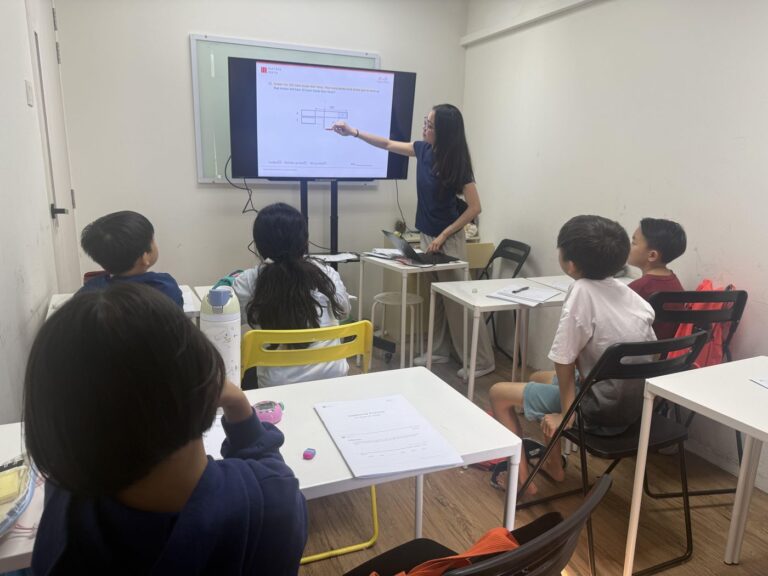
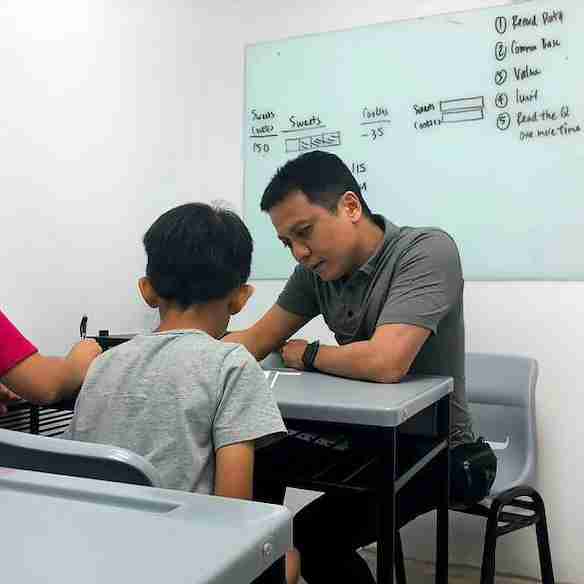
Matrix Math teacher explaining a bar model problem sum to a small primary math class
different 01 icon

A Structured Problem-Solving Approach

The Matrix Method sorts heuristic problem sums into types, then gives your child a five-step process to tackle them: record the data, establish a common base, identify the value, solve one unit, then read the question again. This gives your child a clear place to start for every problem, even when a question looks unfamiliar.

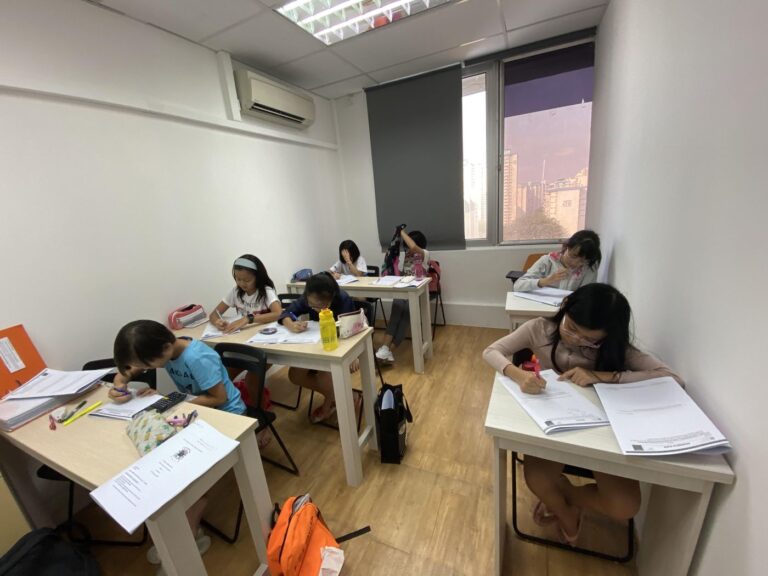
Primary students working on math practice papers in a small-group at Matrix Math
different 02 icon

Small-Group Learning

Preschool classes have up to 4 children, most primary classes have 6 regular students, and secondary classes have up to 8. We believe that small groups help every child to learn optimally and have their whole work checked by the teacher thoroughly instead of just the answer. This helps spot gaps early before they carry into the next topic.

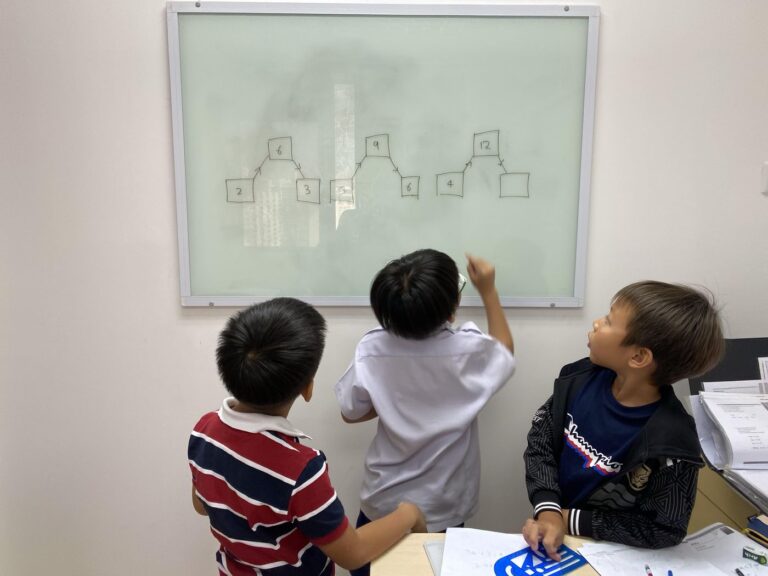
Young students working out a number pattern together on the whiteboard at Matrix Math
different 03 icon

Support for More Independent Learning

Our teachers are trained to encourage students to think critically instead of simply telling them the right answers. Between lessons, we share a weekly synopsis to keep parents updated. Moreover, students can revisit topics independently through review videos on our self-learning portal and the Matrix Math app.

Our Math Tuition Fees in Singapore

Lessons are held weekly and fees are charged per term of 10 lessons. The 2027 term fees below are nett and take effect from 23 November 2026.

Preschool (K1–K2)

From $550

per 10-lesson term
1.5-hour weekly lessons

Primary (P1–P6)

From $560

per 10-lesson term
2-hour weekly lessons

Secondary (Sec 1–4)

From $690

per subject, per 10-lesson term
2-hour weekly lessons

Fees vary by level and may vary by centre. Please contact your preferred centre to confirm fees and class availability.

About Matrix Math

Matrix Math takes pride in how we innovatively approach math education for primary math tuition, secondary math tuition, PSLE revision, and O Level. Originally developed in 2008, our Matrix Method has undergone continuous refinement. Our experienced team of math specialists conduct extensive research, ensuring our programme remains in line with the MOE syllabus and addresses the most commonly tested concepts in schools.

Our Lead Programme Manager

Matrix Method Jason Hiak

Jason Hiak

An alumnus of Nanyang Technological University with a degree in Accountancy, Jason furthered his education with a Master’s from Manchester Business School.

As a Registered Chartered Accountant, Jason combines his deep analytical skills with over 20 years of teaching experience in Mathematics, specialising in primary school math.

His expertise and dedication have made him a key figure in shaping the curriculum and nurturing young minds at Matrix Math.

18 Years of Growing with Our Students

For 18 years, Matrix Math has supported students across different stages of their Math learning journey.

Our students reunite to share their gratitude and fond memories of their journey with us. Many have been part of Matrix Math from primary school through Secondary 4. Their stories highlight the encouraging learning culture and supportive environment we provide, which sets us apart as a leading provider of math tuition in Singapore. At Matrix Math, we inspire a love for problem-solving and foster confidence, helping students excel in their learning journey.

Discover Our Students' Success Stories

Hear What Parents Say About Our Tuition Centre

Find a Matrix Math Centre Near You in Singapore

FAQs About Math Tuition in Singapore

Math tuition provides the additional support that some students may need on top of school. In schools, the attention of the teacher is divided across a class of 40 students. This means that the pace of learning in such a big group may not necessarily be optimal in achieving your child’s academic potential. With Math tuition, foundations are reinforced and learning gaps are bridged. There will also be greater exposure to enhance the mastery of the subject.

Our classes are conducted in a small group of 6. Our curriculum follows the syllabus as stipulated by MOE. Lessons are structured, with topical lessons being taught with guidance as well as a chance for students to assess their own learning through practice questions. We also provide complimentary online review lessons each week to cover the practice questions assigned. This allows for reinforcement of concepts through the additional support.

Our tutors are trained to carry out the lesson in a way that is consistent across all our centres. We use the same materials so that only the most effective methods are delivered with deviations in teaching methods minimised.

We offer hybrid classes, which means that your child gets the flexibility of attending both on-site as well as online. The teacher will be conducting the same lesson to students both on-site and online, delivering effective lessons without compromising on quality.

Matrix Math stands out with its heuristics-based learning approach, which helps students develop strong problem-solving skills rather than relying on rote memorization. We focus on conceptual understanding, ensuring students grasp the “why” behind mathematical principles for deeper learning. Our dedicated and experienced teachers provide personalized guidance, helping students gain confidence and excel. With a proven track record of results, many students show significant improvement in both their grades and problem-solving abilities after joining our programme.

Math Tips and Tricks

Valuable tips and tricks ranging from strategies to combat stress as exams approach to learning effective techniques for enhancing formula memorization.

Is Your Child Ready for Primary 1?

14 November 2026

BY: Jason Hiak

Every year around November, we get the same question from K2 parents: “Is my child ready for Primary 1?” Some have heard that other children are already doing addition and subtraction. Others are wondering if they should buy assessment books over the December holidays. After 18 years of teaching maths at Matrix Math®, here is our honest answer. Most children are more ready than their parents think. But there are a few specific gaps that do cause trouble in the first year, and they are not always the ones parents expect. What MOE actually expects The bar is lower than most parents assume. For maths, MOE says children entering Primary 1 should be able to count up to 10 and understand ideas like “more”, “less” and “the same” (Schoolbag, MOE). That’s it. Your child does not need to know addition, subtraction or multiplication before Day 1. We agree with this. The P1 syllabus starts from the beginning, and teachers expect to build up from there. But there is a catch. P1 maths moves quickly once it starts. By the end of the year, children are working with numbers up to 100, adding and subtracting, telling time, counting money and solving simple word problems. A child who starts with shaky foundations can fall behind within the first term, and catching up is harder than starting right. Before P1 1 → 10 Count to 10 More, less, the same What MOE expects 1 school year By the end of P1 Numbers up to 100 Addition & subtraction Telling time Counting money Simple word problems The starting line is low, but the first year covers a lot of ground. Where children really struggle in P1 maths In our classrooms, the children who struggle in P1 are rarely the ones who “can’t count”. They are usually stuck on one of these five things. 1 Counting by rote, not by understanding. Many children can recite 1 to 20 like a song. Put 7 sweets in front of them and ask “how many?” and some will still touch and count each one from 1, or lose track halfway. Knowing the number names is not the same as understanding quantity. 2 Not seeing that numbers can be broken up. One of the first big topics in P1 is number bonds: seeing that 7 can be 5 and 2, or 4 and 3. Children who only see 7 as “one number” find this hard, and number bonds are the base for nearly every addition and subtraction method that follows. 7 5 2 7 4 3 A number bond shows a whole (top) split into two parts. Same number, different ways to break it up. 3 Reading the question. This surprises parents most. A child may know that 5 + 3 = 8, but get the word problem wrong because they don’t understand “altogether”, “left” or “how many more”. In P1, maths is already partly a language test. 4 Writing numbers correctly. Writing 3, 5, 7 and 9 backwards is very common at this age and usually fixes itself. But a child who writes slowly or unclearly loses time on every worksheet, and that adds up. 5 Working alone. In kindergarten, a teacher is often sitting beside your child. In P1, there is one teacher for a full class. Children who can’t sit and attempt a question on their own for five minutes tend to fall behind, even when they understand the maths. Five quick checks you can do at home tonight You don’t need worksheets for these. A few sweets, some coins or a handful of Lego will do. Check 1 · Count and stopPut 8 objects on the table. Ask your child to give you exactly 6. Do they stop at 6, or keep going? Check 2 · Count onShow 5 sweets, then add 2 more. Ask “how many now?” Does your child count on from 5 (“6, 7”), or start again from 1? Counting on is a sign of real number sense. “I already have 5…” + 67 “…6, 7!” Counting on: starting from 5 instead of counting every sweet again from 1. Check 3 · Split it upGive your child 6 blocks and two cups. Ask, “How many different ways can you put them into the two cups?” A ready child will find two or three ways. Check 4 · Say it in wordsTell a tiny story: “Peter has 4 apples. He eats 1. How many are left?” Watch whether your child understands the word “left”, not just the numbers. Check 5 · Five minutes aloneGive a simple drawing or tracing task and step away. Can they stay on it for five minutes without calling you back? If your child manages most of these comfortably, they are in good shape. If two or more feel like a struggle, that’s worth working on gently over the holidays. It is not a cause for panic. A word of caution: don’t over-prepare This may sound strange coming from a maths enrichment centre, but please don’t spend the December holidays drilling P1 assessment books. A six-year-old who has done the whole P1 book before January often gets bored in class, stops listening, and then misses the method the teacher is building. Worse, a child who learns that maths means hours of worksheets can start to dislike it before school even begins. What works better is short, playful practice. Ten minutes a day of counting things at the supermarket, splitting snacks between siblings, or reading prices together does more than a thick book. The goal is a child who walks into P1 curious and confident, not one who has already seen every question. Want a clearer picture? Try our free P1 readiness check The home checks above give you a rough idea. If you want something more structured, we’ve built a free online test: Is Your Child Ready for Primary 1? About 20 short questions, done together with your child Covers basic number skills and simple problem solving, in
Is Scoring Above 90 Marks Very Difficult for PSLE Math?

16 September 2026

BY: Jason Hiak

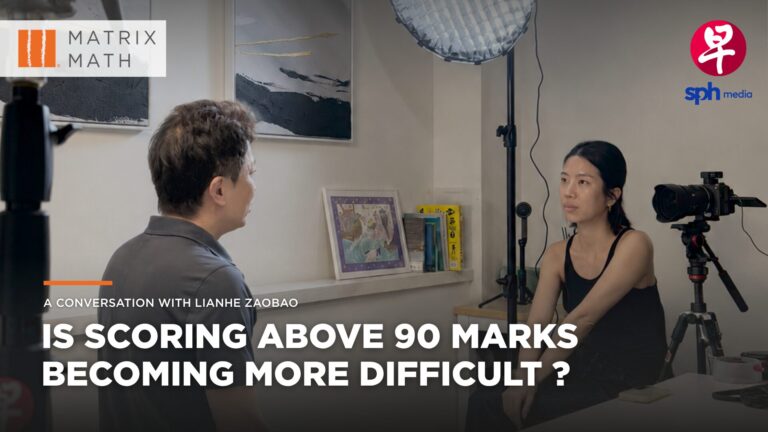
Is Scoring Above 90 Marks Very Difficult for PSLE Math? | Matrix Math For many students, understanding the PSLE Mathematics syllabus is one thing. Consistently scoring above 90 marks can be another challenge entirely. A recent Lianhe Zaobao feature explored whether Primary School Math in Singapore is becoming more difficult. Matrix Math® was invited to contribute to the discussion, with Matrix Math® Director Jason Hiak (郝大吉) sharing his perspective on how the syllabus and examination landscape have evolved. The key difference may not be that students are learning significantly harder Mathematics. Rather, they are increasingly expected to interpret, reason and apply familiar concepts in unfamiliar situations. Has Primary School Math Become Harder? The Primary Mathematics syllabus has undergone several changes over the years, including adjustments to when certain topics are introduced. For example, Ratio and Average are now introduced in Primary 6 instead of Primary 5, while other topics have been moved to earlier levels. These adjustments can change how much time students have to master different concepts. Jason notes that the lighter Primary 5 syllabus can give students more time to strengthen important foundations such as Fractions, Decimals, Percentage and Volume before progressing to Primary 6. However, syllabus changes alone do not fully explain why examinations may feel more challenging. Your browser does not support the video tag. Matrix Math® · matrixmath.sg Matrix Math® Director Jason Hiak discusses changes to the Primary Mathematics syllabus and how assessment has evolved. Why Is Scoring Above 90 So Difficult? One of the biggest changes is how familiar concepts are tested. Students may already know all the Mathematics required to solve a question, but the question may be presented using: unfamiliar wording; a different diagram or context; limited information; or several concepts combined in one problem. Students therefore have to determine what the question is testing before they can decide how to solve it. This is where the difference between memorising a method and genuinely understanding a concept becomes important. A student who has practised many similar questions may quickly recognise a familiar format. But when that format changes, the student must rely on understanding rather than recognition. Your browser does not support the video tag. Matrix Math® · matrixmath.sg Using a 2025 PSLE Math question involving overlapping equilateral triangles, Jason explains how familiar Mathematics can become challenging when presented differently. Knowing the concept is only the first step. Students must also recognise when and how to apply it. — Jason Hiak, Programme Manager, Matrix Math® Knowing the Method Is No Longer Enough Practice remains essential for PSLE Math. However, effective preparation should go beyond repeatedly completing similar questions. Students should also learn to ask: What concept is being tested? What information is important? Why does this method work? Can I apply the same concept if the question looks completely different? This is particularly important for students aiming for the highest scores. The difference between a good score and an excellent score may come down to whether a student can confidently handle the few questions that require greater interpretation and reasoning. Strong Foundations Still Matter Most The ability to tackle unfamiliar questions starts with strong fundamentals. Take Fractions and Percentage as examples. Students may know the individual procedures involved, but more complex questions often require them to recognise the relationship between different quantities before deciding which procedure to use. At Matrix Math®, our curriculum development team therefore focuses not only on teaching students how to solve a question, but also helping them understand why the solution works. Students are exposed to different variations of the same underlying concept so that they become less dependent on memorising specific question formats. Why Are Challenging Questions Included? The Lianhe Zaobao feature also explored the concerns of parents, some of whom feel that Primary School Math questions have become increasingly difficult to support their children with. MOE’s position, highlighted in the feature, is that challenging questions are designed to assess whether students can apply Mathematics in less familiar situations. These questions form only part of the overall paper. The challenge, therefore, is not necessarily that students are being asked to learn Mathematics beyond the Primary School syllabus. Instead, they may be asked to use Primary School Mathematics at a deeper level. Your browser does not support the video tag. Matrix Math® · matrixmath.sg The broader discussion looks at parental concerns, tuition, and why challenging PSLE Math questions are included. So, Is Scoring Above 90 Marks Difficult? It can be. But the difficulty does not necessarily come from learning more advanced Mathematics. For students aiming above 90 marks, the greater challenge is often being able to: recognise concepts in unfamiliar situations; interpret information accurately; connect different ideas; choose an appropriate strategy independently; and remain flexible when a familiar method is not immediately obvious. A student may know how to calculate. A stronger mathematical thinker understands when, why and how to apply that calculation. At Matrix Math®, our goal is to build that understanding by strengthening students’ foundations and developing systematic problem-solving skills that prepare them for both familiar and unfamiliar questions. Math Made Simple. Watch the Full Lianhe Zaobao Feature This article highlights Matrix Math® Director Jason Hiak’s contribution to the discussion. For the complete feature—including perspectives from parents, educators and MOE—watch the original video on Lianhe Zaobao. Watch the Full Feature on Lianhe Zaobao → Want to see how Matrix Math® helps students build this kind of exam-ready reasoning? Contact us today to learn more.

Register for Trial Lesson

footer kids